Showing posts with label forced migration. Show all posts

Monday, October 18, 2010

An email from a ghost: Part III

ParaschosAivali3 The Paraschos family in 1922

To new readers: this is the third post in a series about the search for a lost house in Ayvalik. In order to follow  the narrative, it would be best to start by reading Part I and Part II.

September is a beautiful month in Ayvalik. Every year, at some time during the first two weeks of the month, the temperature drops suddenly: overnight,  the searing summer heat of the Aegean disappears and is replaced by soft sunny days, cooled by breezes off the sea, as the town relaxes into a quiet golden autumn, with the tourists mostly gone and the children back at school. Should you ever wish to visit Ayvalik, September is a very good time to come.

When I imagine September, 1922 in Ayvalik, I see the town bathed in that same soft sunlight, the breeze rustling through the pines, and the fear etched on the faces of  its remaining Greek population, as they are finally forced to accept that the tsunami of the Asia Minor Catastrophe is not, as they had hoped and prayed, going to pass them by.

On the evening of the 24th September, 1922, Dr. Emmanouil Paraschos (pictured above with his family in a photograph taken earlier in 1922) who, like so many others, had been convinced that if the Greeks of Ayvalik stayed put, and stayed quiet, the war would wash harmlessly by them, came home from work in one of Ayvalik’s two hospitals and, deeply distressed and in tears, told his wife Vrysiis that there was no longer any choice in the matter: the time had come for them to leave.

The marauding bands of Turkish irregular soldiers - ‘Tsetes’, in Greek - who had been in the area since August, were now burning Greek villages just along the coast, and killing the inhabitants, he said; soon they would do the same in Ayvalik itself, if any of the Greek inhabitants remained. All able-bodied males over the age of 18 were to be rounded up and sent to labour camps in the Anatolian interior; only the old men, the sick, and women and children would be allowed to leave. There were Allied ships in the harbour waiting to take them  into exile; they would sail the following morning.

Having told his wife, Dr Paraschos dried his tears and, with difficulty,  pulled himself together in order to appear strong and calm whilst delivering this dreadful news to their five children: Athanasios, aged 18, Evmenis, 14, Polyxeni, 12, Kosta, 10, and Yannis, 2.

What was particularly painful for him was that whilst, as  a prominent Ayvalik doctor with many influential Turkish friends, Emmanouil Paraschos had managed to gain an exemption from being sent to a labour camp, and was to be one of the few adult Greek men allowed to leave Ayvalik, he had been unable to obtain any such exemption for his 18 year old son, Athanasios. It was therefore decided that Athanasios would take the risk of going into hiding with Turkish friends, and try to escape to Mytilene later, rather than take the much greater risk of enduring a forced march into the Anatolian interior towards the grim privations of a labour camp.

The family spent the night making preparations to leave their home, possibly for ever. The first thing they did was to cover the windows with blankets, to ensure they could not be seen by any Tsetes who might be roaming the streets already. Then, they set about gathering together what little they could take with them. Vrysiis went to a cupboard and took out 5 blankets, giving one to each of the children. They would be able to take only what they could  manage to carry on their backs, wrapped in a blanket.

When the children had sorted out a couple of changes of clothes each,  a few toys and books, and their stamp collections, they were sent to bed. Then Vrysiis got down to work: she took out  all her jewellery from the box in which it was stored and, through the hours of the night, carefully unpicked the seams of the coats of the family members, inserted  all the pieces of jewellery, and then just as carefully sewed up the seams again so that the jewellery was invisible.

Once the jewellery was sewn up into the coats , and ready to be transported into exile safely hidden,Vrysiis got on with her next task: cleaning the house. It was a matter of honour to her that, whatever the circumstances of their departure, she could not leave behind a dirty house for others to find; so, as the children slept and the darkness of the night began to edge towards a grey dawn, Vrysiis swept, scrubbed and mopped.

Perhaps this mindless, physically demanding activity also helped her to endure the intense fear and anxiety of this terrible night, knowing that in the morning she, her husband  and children would be forced not only to abandon their home and their lives in Ayvalik and sail away to a highly uncertain future, but also to leave behind the family’s eldest son, in a position of great danger. By the time the sun came up over the hills behind Ayvalik, and cast its rays over the Aegean towards Mytilene, the kitchen of the Paraschos house was immaculate, the tiled floor gleaming, all the utensils, ranged on their shelves, sparkling clean.

The next morning the Paraschos family, along with hundreds of others, all carrying similar small bundles of possessions, walked down to the harbour. There the boats were waiting to take them as refugees to the island which lies just offshore, and is clearly visible from Ayvalik:  Mytilene, also known as Lesbos,  once part of the Ottoman Empire, but by 1922 belonging to the Republic of Greece, and a safe haven for the Ayvalik Greeks.

Although the family were able to take some portable valuables – a small amount of money,  jewellery, and  a couple of stamp collections  -  with them into exile,  they left behind virtually everything they owned: a fine, three storey house, one of the beautiful neo-classical stone mansions of Ayvalik, full of  elegant furniture, rugs, china, art, and books; all the possessions of a well to do Asia Minor Greek professional family at the beginning of the 20th century. The Paraschos family  would never be able to reclaim that house, or those possessions, but were fortunate in that they, unlike many others,  escaped with their lives (Athanasios, with the help of Turkish friends, managed to escape to Mytilene and join the rest of the family a few days later).

Those lives would be eventually be remade and lived out successfully in other countries – Greece and  the United States – but the entire Paraschos family would always carry with them, and pass on to their children, and their grandchildren, the sadness of exile, of refugeedom, and the enduring memories of the beautiful house in Ayvalik that was once their family home, on the western shores of Asia Minor, the homeland of their ancestors.

And that lost house was the one I was now trying to find, so far unsuccessfully, on behalf of one of Dr Paraschos’ grandchildren, another Emmanouil (Manny). It happens very often in families that the younger generations fail to appreciate that their older relatives, keepers of the family memories and history, much of it never written down, will not be around for ever to answer questions, and thus it was with the Paraschos family: by the time Manny got round to wondering if it might be possible to find the lost family home, most of the family members who had ever been there were dead, and there were few  clues left as to its exact whereabouts in Ayvalik.

What Manny did find, however, on searching through the papers of his father, Evmenis, the second son, who died in 1975, was several copies of a very small and very dark photograph of a house -

paraschos house2

- and this is the photograph he emailed to me a few weeks ago, as a possible candidate for the Paraschos family house.

His father Evmenis had, in the early 1950s, been permitted to come back to Ayvalik from Greece for a short visit of a couple of days,  and had walked the streets (all by then renamed, in Turkish) of the much changed town, looking for the house he had left as a child three decades earlier. This was not, it should be noted, in an attempt to reclaim the house from its new owners: under the terms of the Treaty of Lausanne, 1923, all those exiled from Turkey to Greece, and vice versa, in the Population Exchange forfeited not only the citizenship of the country they left, but all the property they were forced to leave behind there.

Manny thought that although the photograph of the house was unlabelled, his father must have taken it on this brief visit to Ayvalik. Further, as there were several copies, the photograph must be of some significance: it could well be the family home. This photo, this house, were all, for the moment, that  we had to go on.

Could I find the house in the photograph for him?

You would have to be intimately familiar with the topography of  Ayvalik, the old town spread across several hills sloping down to the Aegean, the warren of  steep, narrow cobbled streets and tiny alleyways, the whole vast mélange of thousands of old buildings, in all possible states of repair and disrepair, from ‘a pile of stones’ and ‘ in ruins’, through ‘partially derelict’ and ‘in need of some urgent attention’, up to and including ‘modernised out of all recognition’, to understand quite how much my heart sank when I saw that photograph.

The photograph was so small and so dark that you couldn’t make out much detail, and since the house in the picture was of only one storey, it was clear that it must be one of the many larger houses in Ayvalik that had lost its upper storey, or storeys, in the major earthquake which hit the town in the 1940s. Along with the upper part of the house would have gone a lot of distinguishing detail: there are many once sizeable houses in Ayvalik with missing upper storeys and, to the casual glance at least, they all look rather alike.

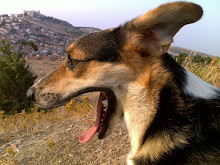
I sat and stared at the photograph, rather dispiritedly. I imagined spending the next few weeks wandering the streets of Ayvalik, a print-out of the photo in hand, trying to find anything that resembled it. The old town of Ayvalik is BIG. It has a number of separate neigbourhoods, with some of which I am only passingly familiar. Although I’ve lived here for over two years, and walk around with my dog Freddie every day,  I’m still constantly discovering streets and alleys which I have never ventured down – or, more likely, as the town is built on hills, up – before. I live in the lower part of the town, equidistant between the pine woods and the sea, but this house could be anywhere, if it still existed at all.

I continued to stare miserably at the photograph, beginning to regret that I had so blithely undertaken the task of finding the Paraschos house. Then I noticed something. On the left hand side of the photograph, on the opposite side of the narrow street from the house which might or might not be the Paraschos house, there was a house with a protruding window on the first (or for Americans, the second) floor, a common feature of Ottoman, and Ayvalik, architecture. What was unusual about it, though, was that the window looked very low, not more than 8 or 9 feet above the ground; generally, in this town of tall, thin 3 storey houses, they are much higher, as in the photograph below:

091020105772

I vaguely remembered  walking down a street with just such an unusually low protruding window, one low enough so that you could reach up and touch it, only a few days before  - but where the hell had it been?

Then I remembered that I’d been in the street to photograph a horse and cart I spotted tied up there, and that the low protruding window had been somewhere beyond the horse and cart. Going into the photo files on the computer, I started to search and eventually found this embarrassingly incompetent photograph, with the light all haywire, which would never be seeing the light of day on this blog were it not an important step in the search for the Paraschos house:

240820104678[1]

However, my photographic deficiencies notwithstanding, if you look closely at the photograph you can see that behind the heap of tomatoes in the cart is a protruding window, not very high up, opposite which is a line of low one storey buildings. 

Now go back and look at the photograph Manny sent me, of the house with a similar low protruding window opposite the one storey house, bearing in mind that the two photographs are taken from the opposite ends of their respective streets, one showing the window on the right, one on the left.

That night I looked at one photo, then the other, back and forth, over and over again. Could these two photographs, taken from different angles, be of one and the same street? Could I have already found the Paraschos house, without knowing it, on the day I had recently spent photographing horses and carts (still a common form of  transport  in Ayvalik)?

It certainly seemed possible, as there was clearly a striking similarity between the two streets pictured in the photographs, but the only way to tell would be to go and look at that street again, with a copy of the photograph Manny had sent me. I glanced at my watch. It was nearly midnight. I looked over at Freddie, who  was stretched out on his blanket on his designated sofa, looking about as comfortable as it was possible for a dog to be:

freddie recumbent

Freddie  did not look like a dog who wanted to go anywhere anytime soon.

Well, tough.

We were on a mission.

Perhaps not a Mission from God, but a mission, just the same.

‘C’mon Fred,’ I said briskly. ‘We’re going for a walk.’

(to be continued)


The image below shows the diary entry of Manny’s father, Evmenis Paraschos, then 14 years old,  for 25th September, 1922, the day the family left Ayvalik (also known in Greek as Kidonies) to go into exile.

 PapouEvmDiary1TRANSL

Many thanks to the Paraschos family for providing me   with the images used above, and also for sharing their collective memories both of the family’s life in Ayvalik and their experience of becoming refugees, on which much of this post was based.

Monday, September 13, 2010

An email from a ghost

couple

Exactly a month ago I received an email from a man in America. The email opened without salutation: the writer merely said that he loved my blog, and was passing it on to others, a statement guaranteed to make me feel warmly towards him, whoever he might be. He then went on to say ‘I need some information you might know something about’.

What, I wondered, might that be?

The next paragraph made my jaw drop: I was stunned.

‘My father's family was from Aivali. His father was a physician at the hospital there. Is there a way to find out where the Emmanouil Paraschos  (Εμμανουήλ Παράσχος) family lived until 1922?’


I live in a town full of ghosts. The Greeks who lived here until 1922 hover constantly at the edge of one’s vision, a shadow population peering from the empty windows of  ruined houses, and only ever glimpsed in the few photographs* that remain of life here a hundred years ago:  middle class couples, like the one above,  in a formal pose for the photographer, confident of their place in the world; families in their Sunday best ready to attend mass at the Greek Orthodox churches that now have minarets attached;

PapaKonstandios%20et%20al_1

children lining up in solemn-faced rows for school photographs;

8

and a young girl  in a white dress, gazing calmly into the future, unaware that her childhood was about to come to an end and that her adult life, if she survived the coming catastrophe, would be lived in another country:

mother&daughter

The disjunction between those sad spectres of the past and the town in which I live has always seemed complete; when I talk to people who live here now about their family backgrounds, they tell me that their grandparents and great grandparents came here from Salonika, or Mytilene, or Crete. There is literally no one in Ayvalik today whose ancestors were here before 1923. They are gone, lost to history, and can never come back.

Yet when I read the email from the professor in Boston, a man called Manny Paraschos  named, it seemed,  for his grandfather, it was as if someone had suddenly stepped straight out of one of those old photographs, waving, and shouting ‘Hey! We’re still here!’ 

I had received an email from a ghost.

When I started writing this blog, I imagined its possible readers as people like me: interested in, but largely ignorant of,  both modern Turkey and the many previous civilisations and empires which rose and fell, flourished and  faded, during the last 9,000 thousand years in Asia Minor. It simply never occurred to me that the blog would be read by anyone in the diaspora of Asia Minor Greeks.

I wrote back to the professor immediately, expressing my delight at making a connection to someone now living who had his roots in that lost world, and offering to help him in any way I could in the quest to identify his ancestral home. If he had no address for the Paraschos family house, as was implied by his question, then I would try to approach the problem from another angle: I knew that population censuses list the names of all the people living at any given address, so if there were any pre-1922 census records for Ayvalik still extant, I could search them to find any mention of the  name  ‘Paraschos’.

Another possibility might be the Property Records Office of the Ayvalik municipality. My own house was built in 1908, only 14 years before the Greeks left, so I imagined it might only ever have been occupied by one family, and I remembered a friend telling me that if I wanted to find out who used to live in my house, I might be able to do so at the Property Records Office, where the land registration deed should record the name of the house’s first owner. Without an address, it would be more difficult, but it was possible that the details from land deeds had been computerised, and one might be able to search by name, rather than address.

I outlined these possibilities, both of which  seemed to offer at least some slim chance of success, to Manny, and undertook to discuss the problem with a Turkish friend here, who has a strong interest in, and considerable knowledge of, local history. However, not wishing to get his hopes up too high, I added the following caveat: that many records had been destroyed during the cataclysmic events in Anatolia between 1919 and 1923, and that even if we could manage to find  the address where the Paraschos family lived, the house might be a ruin, or have disappeared completely and been replaced by a new building. I would do my best to help him find his family home, but  was, in truth, doubtful of a successful outcome.

Still, it was a fascinating quest, and I was determined to try. I arranged to have lunch the next day with the friend who might be able to advise me on my search, and bought a new notebook, on the basis that all great –or even small – enterprises should begin with a new notebook and a Pilot pen with a very, very fine point.

Project Paraschos was now officially underway.

(to be continued)

moschonisi-family5

* Please note that these photographs of  Greek families in Ayvalik before 1922, from publicly available sources, are not of the Paraschos family.

Sunday, July 11, 2010

Where the bodies are buried

 DSC00188

There’s a place up in the woods where my dog always goes quite crazy.

One moment Freddie is bounding along happily, his ears and tail flapping in the breeze, full of doggy joy at being out in the woods and running free. Then, always in exactly the same place, he suddenly stops dead and starts snarling and growling, running round in ever decreasing circles, snapping and lunging, as if facing up to some unseen enemy. But of course there is nothing, and no-one, there.

I often wonder if this might be where some of the bodies are buried.

My last post described how in September 1922 The Orthodox Greek Christian population of Ayvalik was expelled by the  Turkish army: 3,000 able-bodied males over the age of 18 were sent on forced marches to work camps in the Anatolian interior – from which only 23 ever returned -  whilst women, children and the elderly were evacuated onto boats which took them to Greece.

Not everyone left, though.

Ayvalik and its neighbouring island of Cunda constituted an important centre for Orthodox Greek Christianity. There were nearly 50 churches and monasteries in the area, including the  Taksiyarhis Cathedral on Cunda (seen in the photo below as it is today, empty and unrestored) , seat of the local bishop, Gregorias Orologas.

 cundacathedral


The Greeks of Ayvalik, and their clergy, had traditionally enjoyed good relations with the Ottoman authorities. In 1770 an Ottoman admiral, Cezayirli Gazi Hasan Pasha, commanded  an Ottoman fleet heavily defeated by the Russians in the Battle of Chesma, a  short way down the coast from Ayvalik. As they escaped,  the admiral and some of his men  were given shelter in Ayvalik by a Greek priest  unaware of who they were.

When Hasan Pasha later became Grand Vizier of the Ottoman Empire, he showed his gratitude by granting Ayvalik virtual autonomy as a Greek enclave within the Ottoman domains, with self-government and exemption from many taxes. Ayvalik prospered, and went on to become the second most important Greek commercial and cultural centre on the Aegean coast, after Smyrna. The town’s prosperity was derived principally from the olive oil industry, and its wealth was evident  not only in the grand neo-classical stone mansions of  wealthy merchants, but also in the magnificent churches of Ayvalik and Cunda.

taksiyarhis2

The Asia Minor Greeks, it should be remembered, did not disappear from Anatolia overnight: it was a long, slow, agonising process bracketed at one end by the start of  the Greek War of Independence against the Ottoman Empire in 1821, leading to  the creation of the Greek Republic in 1832, and at the other end by the Population Exchange between Greece and Turkey under the Treaty of Lausanne, in 1923.

Thus by the time the last of the Ayvalik Greeks were evacuated in 1922, the people of Ayvalik had already been affected by the gradual  worsening of relations between Muslims and Christians within the Ottoman Empire from Anatolia to the Balkans, and in particular had suffered a great deal during the Turkish War of Independence, when they were accused of collaborating with the invading Greek Army.

Nevertheless, even with the Greek army  defeated, Smyrna burned to the ground, and the victorious Turkish army approaching Ayvalik, it was impossible for the inhabitants to believe that Ayvalik’s 300 year  history as an Asia Minor Greek town was over.  At this point, the local authorities made a huge error: they docked  all the boats to prevent people from leaving, in the hope that this demonstration of good faith to the Turks would lead to the  safety of the townspeople, and in time a return to Ayvalik’s previous well-ordered existence.

The chairman of the meeting which made this decision was Bishop Gregorios Orologas, and he was also at the head of the deputation welcoming the Turkish cavalry when they rode into town on September 19th, 1922. Unfortunately this warm welcome for the Turks, which also included an entertainment  with music and dancing, made no difference at all to the fate of the Ayvalik Greeks, who were shortly afterwards dispersed as described above.

And the ones who didn’t leave?

The following passage is  from 'Twice A Stranger',  Bruce Clark’s fascinating, and definitive, book about the Population Exchange, which has a chapter entitled ‘Ayvalik and its ghosts’* :

‘Gregorios and all the other clergy of the town were taken to a lonely spot outside the town and killed: the bishop is said to have died of a heart attack shortly before an attempt to bury him alive. Ironically some of those who died were choristers and vergers who donned clerical clothes in the belief that they would be treated with greater respect.’

060720103716

In that place up in the woods, the lonely place high above the sea where Freddie always goes crazy, the ground undulates strangely, in a way quite atypical of the local landscape. The rest of the hilltop  is flat, but in this one area there is a series of low mounds and hollows, as if the earth was disturbed there a long, long time ago.

And every time Freddie’s hackles rise, and he starts growling and yapping and chasing things that aren’t there, I wonder if this place might be where some of those bodies are buried.


* My posts about the Population Exchange draw heavily on this book, which is by far the best English language source on the subject.

Thursday, June 17, 2010

Churches with minarets


Why do the churches in Ayvalik have minarets?

Or, to rephrase the question, why are all the mosques in the old town of Ayvalik actually old Greek Orthodox churches, rather poorly disguised by the addition of minarets?

The answer is - well, how long have you got?

The very short answer is that in October 1922 the original Greek Orthodox Christian population of Ayvalik left suddenly, and was replaced by in 1923 by Turkish Muslims, who later turned the abandoned churches into mosques.

The slightly longer answer  is that after the First World War, the collapse of the Ottoman Empire, and the Turkish War of Independence, with the victory of the newly emergent Turkish state over the invading army of the newly emergent Greek state, the 30,000 Orthodox Greek Christians of Ayvalik (effectively the entire population of Ayvalik), were forced to leave their ancestral homes (Ayvalik had been an Asia Minor Greek town for 300 years, although part of the Ottoman Empire), and to migrate to Greece.

They were either put onto boats, and forcibly deported to Greece or, if unlucky enough to be male and over the age of 18, sent to forced labour camps in the Anatolian interior, from which few ever returned. They were replaced by a much smaller number of Muslims, many Greek-speaking, from the island of Mytilene (also known as Lesbos) which lies just offshore, from Crete and from other Greek territories now part of Greece, but formerly part of the Ottoman Empire, who were similarly forced to leave their ancestral homes to move to the new, primarily Muslim, nation state of Turkey, created from the ashes of the Ottoman Empire.

These forced migrations were part of the much bigger Population Exchange which was taking place between Turkey and Greece at the time, and later ratified by the Treaty of Lausanne, in 1923. This was based purely on religious identity: one and half million Greek Orthodox citizens of Turkey and 500,000 Muslim citizens of Greece were forcibly deported from their homes and sent to live in the other country, where they would form part of the religious majority.

None of the 2 million people involved had any choice in the matter: their lives were torn apart because the international powers had agreed that in order to avoid further conflict Turkey should be primarily Muslim, and Greece primarily Christian. Unfortunately for them, those 2 million people were living in the 'wrong' place for their religion, and because of that were forced to migrate, as penniless refugees, to places where many of them could not even speak the language.

Those are the bare facts about what happened to the Ayvalik Greeks who suddenly disappeared and left all those churches behind, and the people who came in to replace them and turned their churches into mosques. A more comprehensive explanation of why this happened, however, would have to take in both the 3,000 year history of the Asia Minor Greeks, and the rise and fall of the multi-cultural Ottoman Empire and its replacement by the rather more culturally homogenous and less religiously tolerant Turkish Republic. This followed the First World War, the ill-advised Greek invasion of Anatolia in 1919 and the subsequent vicious and bloody Turkish War of Independence, which ended with the Greeks being driven back, quite literally in some cases, into the sea.


That's all rather too much for one blog post, though.