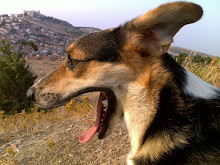
Showing posts with label walking Freddie. Show all posts

Friday, May 6, 2011

Walking on wild flowers

yellow, pink and sea2

It’s been a long time since I’ve posted here on the Camel Barn Library, and many people have asked me in the last few months, with varying levels of impatience, if I am EVER going to finish the saga of the Paraschos house, and finally satisfy everyone’s curiosity by giving them a look inside it.

Please accept my apologies, patient – and not so patient – readers. I am well aware of how annoying it is when a story stops abruptly, without finishing, and my only explanation is that life got away from me, rather, during the autumn and winter and so, by extension, did the blog.  But now it’s spring-time in the Aegean, and time to get going again with the blog, and much else. I will be returning to the subject of the Paraschos house shortly, but to celebrate restarting the Camel Barn Library, and to remind both myself and you just why I love this place so much, today’s post  is simply about walking in, and on, the wild flowers which cover the wooded hills around Ayvalik at this time of year.

Ayvalik is both built on and surrounded by hills, and if we walk straight up the steep sokaks (alleys) which lie behind the Camel Barn – no inconsiderable feat for me, though less so for my dog Freddie, who likes nothing better than bounding his way uphill on a brisk vertical run, preferably in pursuit of a motorbike – we can be in the woods in less than 10 minutes. The trees are mostly the graceful Mediterranean umbrella pines that grow throughout Southern Europe, North Africa, and the Levant.

purple and pines

The pines maintain their vivid greenness throughout the year, which is particularly welcome in the intensely hot, dry summer months, when all the undergrowth dries up and the ground becomes uniformly dun-coloured; at this time of year, however, the grasses are green and flourishing and so are many species of wild flowers, notable amongst them lavender and dog roses, endless acres of which cover the rocky ground in between the trees:

lavender ad inf

dog roses, lavender2

Although all the woods around Ayvalik are lovely, the areas closest to the town are sadly marred by litter, and fly-tipping. People here don’t, on the whole, use the woods for walking, running, or dog-walking; in the warm months they come to the woods by car or motor-bike, and leave behind them a constantly replenished tide of broken bottles, cigarette packets, plastic bags and other detritus. Builders also frequently dump piles of building rubble by the road going through the woods, even though the town tip is only a five minute drive away:

building rubble in woods

The constant desecration of a place of such astonishing natural beauty makes me want to weep; this is a problem that is found throughout Turkey, and not just in Ayvalik, and also of course in Europe, although I’ve never seen it on such a large scale anywhere else. The town council recently put up a couple of notices on the road that winds through the woods, forbidding the dumping of rubbish; the very next day I saw, walking past, that someone had neatly deposited a heap of building rubble just underneath one of the new notices.  A few days later, approaching the same spot, I saw black smoke billowing into the air: someone had tipped an old sofa down the hillside, and set fire to it.

sofa on fire2

However, if you walk far enough through the woods, away from the town, you eventually get further than people can be bothered to go to drink beer, or dump their rubbish; you can then walk for miles over the hills along unmade fire roads, free of human detritus, and the only people you are likely to encounter are beekeepers. The Ayvalik area is famous for its pine and wildflower honey, and throughout the woods are neat lines of beehives, each weighted down with a stone to prevent its lid being blown away by the frequent high winds.

beehives among the flowers

The beekeepers can be found, occasionally, tending to their hives, dressed in their slightly spooky beekeeping outfits, with veils attached to wide-brimmed white hats.

beekeepers in the woods

Apart from the beekeepers, no one else much seems to frequent the more remote parts of the woods, except me and Freddie. The  only sounds are the wind, sighing through the pine trees, the occasional buzzing of the bees, and the scrabbling of Freddie’s paws as he excavates yet another hole amongst the flowers:

freddie digging hole amongst flowers2

The further you go, and the higher you get, the more wild flowers there are, and after about 90 minutes’ walking there is a wide, steep track, climbing to a high point from where you can look inland towards the mountains, and out across the sea. This track  is, for a couple of weeks a year, completely carpeted in purple flowers:

purple flowery road 

the only way is up

By the time we get to the top of the purple flowery road, Freddie and I will have been walking for a couple of hours, and are ready to take a rest on the summit of the hill, from where we can look out over the Aegean to the islands of the archipelago, and back across the hills to Ayvalik (which you can see just to the right of Freddie’s head in the photo):

Freddie in the flowers

It’s a long walk home, but during April and May we walk this way as often as possible; it’s always beautiful in the hills around Ayvalik, but when the wild flowers are blooming in such spectacular abundance, the beauty is quite overwhelming.  It seems strange that so few people walk in the hills, or see the flowers, but in 3 years of regular walking through these woods, we have met only a handful of people. It’s rather like having our own private National Park…

To my shame, I am unable to give a name to most of the many different species of flowers which are currently blooming here, beyond the obvious lavender, dog roses, daisies and poppies; next year I will have to buy a field guide to the flora of Asia Minor, and see how many different flowers I can identify, but to give you an idea of their variety, the picture below shows a small bouquet I gathered last week for a friend whose health currently prevents her from walking in the hills  - and yes, I know that in the UK you’re not meant to pick wild flowers, but here there are, quite possibly, millions of them, mostly blushing unseen. I feel extraordinarily fortunate to be able to spend so much time walking through the flowers, marvelling at their beauty, and immersing myself in the deep, deep quiet of the woods.

bouquet of wild flowers

Wednesday, July 28, 2010

Street Life

260720103963

The great heat of July is upon us; it is the price we pay  for the glorious months of sunny, warm weather in the spring and autumn. July is the hottest month: the heat of August is always tempered by strong winds blowing from the north –‘Ayvalik air-conditioning’ – but in July, when the temperature is often in the high thirties, and occasionally the low forties, there is little relief from the  heat unless you sit by the sea, or climb up the hill to the woods, in both of which places you can generally find a cooling breeze.

In the old town of Ayvalik, many of the residents are quite poor, and air conditioning units are unusual.  Most of my neighbours simply have to endure the stifling heat , and during the summer months a large part of their time is spent outside, in gardens, on roof terraces and balconies, but also in the cobbled streets in front of their houses.

villageladies

Many of the people here are recent migrants from villages in the east of Turkey; although now living in the town, they manage an approximation of the village life they left behind, often keeping chickens or, on the higher ground up near to the woods, a few sheep or goats.

goats2

The companionable evenings spent sitting outside on the street are a relic of village life and, as the weather gets warmer, pieces of furniture begin to creep outside to make this outdoor living more comfortable. When Freddie and I climb up the hill at 6.30 a.m to walk in the comparative cool of the very early morning, the sofas and chairs lie empty, and look a little incongruous:

010720103462

In the heat of the afternoon the streets are quiet, as it is simply too hot to be outside, but with the approach of  evening, as the shadows lengthen and the heat begins to abate, people start to emerge from their houses.2littleboys

Soon the cobbled streets burst into life again, with children playing energetic games to work off the energy accumulated whilst cooped up inside for the afternoon;  their parents, meanwhile,  sit outside their houses and chat with their neighbours.

Children here spend far more time outside and have infinitely more freedom than in England; whenever I feel slightly irritated at the foghorn cries of the little boys who play football in my street, I remind myself that this is what little boys are meant to do.

smallboy

Hilary Clinton’s dictum that ‘It takes a village’ to raise a child  can be seen in action here: even very small children play outside in the streets unsupervised, as there is always a neighbour around to watch out for them, and few strangers wander around in the cobbled streets and alleys that wind their way up the hill in the old town.

By the time Freddie and I return from our evening, walk, around sunset, the sofas and the front doorsteps are fully occupied:

050720103688 

When you walk a dog every day along a regular route, you become part of people’s mental furniture. They look out for you,  exchange greetings, express concern if you have failed to appear for a few days and gradually, although you don’t really know each other, you become friends of a kind.

sardya2

The woman in the photograph above is called Sardya, although I'm not sure if that's exactly how you spell it. She sits outside her house every evening in the spring and summer, when the weather is good.  Freddie and I have to climb up a very long, very steep flight of steps to get up to the street where she lives, which leads straight up the hill into the woods. One day, seeing me breathless after the climb, Sardya motioned to me sit down and catch my breath, and we talked for a while.

Now we have become friends, across the gulf of culture, language, age and experience that separates us. Sardya has a kind of tranquil beauty which quite transcends age.  I don’t know her life story yet, except that she was born in the house where she lives, and has lived there her whole life.  Her calm gaze seems to be that of a woman who has seen a lot, and come though unscathed. She always looks out for me and Freddie, and I like her very much.

Tuesday, June 8, 2010

If you go down to the woods today...

Truly, for my next post I was intending to write about the Treaty of Lausanne, 1923, and its catastrophic effect on the people inhabiting Ayvalık at the time. And I will, I will. But I have been waylaid by a puppy, and this is he.


At the moment the puppy's Coke bottle chewy toy is somewhat bigger than him, but he is a Kangal, or Anatolian sheep dog, the Turkish national dog (and, perhaps, symbol of national virility) which means that one day he will be the size of a Shetland pony, thus:


And I am to be his godmother.

Down in the valley between the two ranges of pine-covered hills along the coast south of Ayvalık, there is an unmade track running between olive groves, and this constitutes the homeward arc of Freddie's and my circular walks, once we have climbed up the hills, gazed at the views over the sea, and then come downhill again through the pine woods.

I have recently become friendly with a man I often see down there who owns a ramshackle, unfinished farm house apparently being built without benefit of a plumb line.


The house is surrounded by many interesting artefacts, not least among them several boats in varying states of repair, an unexploded Greek mortar shell dating back to the Turkish War of Independence, and many examples of what is probably best described as 'Outsider Art': think Steptoe, amongst the olive groves.


My new friend, M, tells me that he is a man who like animals much better than people. The truth of this statement is evident from the menagerie that lives in the enclosure surrounding the farmhouse. M keeps rabbits, ducks, hens and six dogs of varying sizes.


One day M invited me into the compound to have a cup of tea, and to meet the animals. He let me play with the puppy for as long as I liked, and sent me home with a handful of newly laid eggs. Now, if he's around when Freddie and I walk past, we often sit and chat for a while. Although he owns other properties in Ayvalik and elsewhere, and presumably has some kind of other life to fund this bucolic idyll, M spends as much time as possible down here tending his animals, his vegetable garden and his olive grove, and having his friends over in the evening to drink beer and cook stuffed mussels (an Aegean speciality) over an open fire.

Although M is not fond of people in general, I am acceptable because I come with a dog attached. Freddie loves it down on the farm, as there are five other dogs for him to run around with. The puppy is too small for that yet, and during my visits spends most of his time curled up in my lap.

The puppy is a relatively new arrival, and a few days ago M asked me if I would like to think of a name for him. I felt honoured, and gave the matter much thought, considering numerous alternatives before returning to my first idea: Utku, which means 'triumph' or 'victory' in Turkish, and was the name of a student I taught in Ankara. I love the sound of this name, and have previously bestowed it on one cat (now deceased), and on the fighting camel I fell in love with last year, and whom I long, passionately, to own.


But it also makes a hell of a good name for a puppy that will one day be 4 feet tall. Yesterday, I told M that the puppy's name would be Utku, and he seemed pleased. He picked the puppy up and said 'Utku, Utku, Utku', kissing the puppy in between each repetition. That, he said, made the name official.


Then he invited me to come back to the farm this evening for a christening party - this being Turkey, I am translating freely here - for Utku at which, I understood him to say, there will be cake. Naturally, I accepted, and am now wondering what might be an appropriate christening gift for an Anatolian sheep dog puppy to whom I seem to have been appointed de facto godmother.

I'm thinking in terms of a big, juicy bone.