Showing posts with label walking. Show all posts

Sunday, July 11, 2010

Where the bodies are buried

 DSC00188

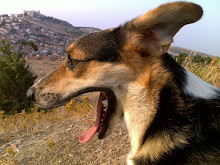
There’s a place up in the woods where my dog always goes quite crazy.

One moment Freddie is bounding along happily, his ears and tail flapping in the breeze, full of doggy joy at being out in the woods and running free. Then, always in exactly the same place, he suddenly stops dead and starts snarling and growling, running round in ever decreasing circles, snapping and lunging, as if facing up to some unseen enemy. But of course there is nothing, and no-one, there.

I often wonder if this might be where some of the bodies are buried.

My last post described how in September 1922 The Orthodox Greek Christian population of Ayvalik was expelled by the  Turkish army: 3,000 able-bodied males over the age of 18 were sent on forced marches to work camps in the Anatolian interior – from which only 23 ever returned -  whilst women, children and the elderly were evacuated onto boats which took them to Greece.

Not everyone left, though.

Ayvalik and its neighbouring island of Cunda constituted an important centre for Orthodox Greek Christianity. There were nearly 50 churches and monasteries in the area, including the  Taksiyarhis Cathedral on Cunda (seen in the photo below as it is today, empty and unrestored) , seat of the local bishop, Gregorias Orologas.

 cundacathedral


The Greeks of Ayvalik, and their clergy, had traditionally enjoyed good relations with the Ottoman authorities. In 1770 an Ottoman admiral, Cezayirli Gazi Hasan Pasha, commanded  an Ottoman fleet heavily defeated by the Russians in the Battle of Chesma, a  short way down the coast from Ayvalik. As they escaped,  the admiral and some of his men  were given shelter in Ayvalik by a Greek priest  unaware of who they were.

When Hasan Pasha later became Grand Vizier of the Ottoman Empire, he showed his gratitude by granting Ayvalik virtual autonomy as a Greek enclave within the Ottoman domains, with self-government and exemption from many taxes. Ayvalik prospered, and went on to become the second most important Greek commercial and cultural centre on the Aegean coast, after Smyrna. The town’s prosperity was derived principally from the olive oil industry, and its wealth was evident  not only in the grand neo-classical stone mansions of  wealthy merchants, but also in the magnificent churches of Ayvalik and Cunda.

taksiyarhis2

The Asia Minor Greeks, it should be remembered, did not disappear from Anatolia overnight: it was a long, slow, agonising process bracketed at one end by the start of  the Greek War of Independence against the Ottoman Empire in 1821, leading to  the creation of the Greek Republic in 1832, and at the other end by the Population Exchange between Greece and Turkey under the Treaty of Lausanne, in 1923.

Thus by the time the last of the Ayvalik Greeks were evacuated in 1922, the people of Ayvalik had already been affected by the gradual  worsening of relations between Muslims and Christians within the Ottoman Empire from Anatolia to the Balkans, and in particular had suffered a great deal during the Turkish War of Independence, when they were accused of collaborating with the invading Greek Army.

Nevertheless, even with the Greek army  defeated, Smyrna burned to the ground, and the victorious Turkish army approaching Ayvalik, it was impossible for the inhabitants to believe that Ayvalik’s 300 year  history as an Asia Minor Greek town was over.  At this point, the local authorities made a huge error: they docked  all the boats to prevent people from leaving, in the hope that this demonstration of good faith to the Turks would lead to the  safety of the townspeople, and in time a return to Ayvalik’s previous well-ordered existence.

The chairman of the meeting which made this decision was Bishop Gregorios Orologas, and he was also at the head of the deputation welcoming the Turkish cavalry when they rode into town on September 19th, 1922. Unfortunately this warm welcome for the Turks, which also included an entertainment  with music and dancing, made no difference at all to the fate of the Ayvalik Greeks, who were shortly afterwards dispersed as described above.

And the ones who didn’t leave?

The following passage is  from 'Twice A Stranger',  Bruce Clark’s fascinating, and definitive, book about the Population Exchange, which has a chapter entitled ‘Ayvalik and its ghosts’* :

‘Gregorios and all the other clergy of the town were taken to a lonely spot outside the town and killed: the bishop is said to have died of a heart attack shortly before an attempt to bury him alive. Ironically some of those who died were choristers and vergers who donned clerical clothes in the belief that they would be treated with greater respect.’

060720103716

In that place up in the woods, the lonely place high above the sea where Freddie always goes crazy, the ground undulates strangely, in a way quite atypical of the local landscape. The rest of the hilltop  is flat, but in this one area there is a series of low mounds and hollows, as if the earth was disturbed there a long, long time ago.

And every time Freddie’s hackles rise, and he starts growling and yapping and chasing things that aren’t there, I wonder if this place might be where some of those bodies are buried.


* My posts about the Population Exchange draw heavily on this book, which is by far the best English language source on the subject.

Sunday, June 6, 2010

The truth about cats and dogs...

I awake to the realisation that I left the kitchen door open last night and that not one, but two, feral cats are in the house.

Shortly afterwards Freddie, my dog, realises this too.


There are breakages.

For does not an old Turkish proverb say: 'A terrified cat will always choose to rampage through a tray of wine glasses rather than head for the door standing wide open'?

After several minutes of extreme havoc and a considerable amount of collateral damage, the feral cats are ejected. I sweep up all the broken glass, feed the dog and yowling resident cats, and take a cup of coffee into the courtyard to sit awhile and regain my equilibrium.


I sink gratefully into the Lloyd loom garden chair and raise the mug of coffee to my lips, but even as I finally take the first sip of coffee of the day, a loud clacking noise starts coming from inside the camel barn. I sigh, knowing what the noise is. My cat Ollie is sitting inside the camel barn, batting the door of the cat flap back and forth with his paw. CLACK! CLACK! CLACK! goes the door. He will continue doing this until I get up, walk over to the camel barn doors, and lift up the cat flap door from the outside, thus allowing him unimpeded egress from the camel barn into the courtyard.


Ollie is 15, very old in cat years, and I indulge him in this practice on the grounds that he may be going senile and have forgotten how to use the cat flap. The possibility remains, however, that he simply sees no necessity to bother with pushing his way through the cat flap when an indentured servant is available to do it for him. I strongly suspect that he manages to get through that door perfectly well on his own when I am not in the vicinity.

With Ollie ushered safely through the cat flap I manage, finally, to drink a few sips of coffee and sit back in my chair, enjoying the scent of the jasmine growing up the courtyard wall.

Then two things happen simultaneously: Ollie strolls over to the flower bed in which the jasmine is planted, just next to where I am sitting, and defecates neatly, and copiously, right in the middle of it. The scent of the jasmine is immediately replaced by something infinitely less pleasant. Meanwhile, Freddie begins to exacavate, with enormous, earth-spattering enthusiasm, the large terracotta pot in which I have recently planted some not particularly robust geraniums.

Once I have disposed of Ollie's little gift and swept up the earth and broken flowers, I bow to the inevitable and decide to take Freddie for a long walk to dissipate some of his energy. As I re-enter the house via the camel barn, in which I will be entertaining some friends for dinner this evening, I notice a very strong odour of Eau du Feral Cat, a souvenir of last night's uninvited guests. When a cat sprays the smell is both disgusting and extremely difficult to eradicate. At this point it becomes necessary, for the sake of my mental health, to move into a state of extreme denial, and I decide to think about this problem later.

Freddie and I set off on our walk, and make our way up to the pine woods with only two motorcycle-chasing incidents (not bad going), and no one moved to throw anything at Freddie or me because they don't like dogs (also good). The day is looking up. We continue to climb and, after an hour or so, get to the high point of the walk, where there is an extraordinarily beautiful view over the Aegean and the islands of the Ayvalik archipelago, shown here in a photo taken last week:


At this very moment, however, as Freddie sits on the ground panting happily and I, gazing at the view, am struck anew by the incredible beauty of this place, the electrical storm which has been threatening for several days finally arrives, with thunder, spectacular lightning effects and torrential rain. We are some distance from any form of shelter, and within minutes I am soaked to the skin. I sit down on the wet ground next to my big, wet dog, give him a big, wet hug and, huddled together, we sit and watch the sheet lightning illuminate the sky over the sea.

Tuesday, June 9, 2009

The joys of solitude...


At the mid-point of my early morning walk, I sit on a large flat rock up on the pine-wooded hills surrounding Ayvalık, from where there is a view over the old town, the bay, and across the Aegean to the mountains of the island of Lesbos (called Midili by the locals), which lies a few miles offshore.

This morning, as I sat there drinking water and letting my brain soak up the extravagant blueness of the sea and the sky, I noticed a woman climbing up the very steep slope below me. I walk to this place by a circuitous route with a much gentler gradient, and was surprised to see someone scrambling straight up the hill. As she drew nearer, I saw that it was a village woman, laden down with various items: a huge empty plastic water container, a wicker basket, and what looked like some kind of agricultural tool. She was probably on her way to work on one of the farms that lie on the other side of the pine woods.

I say ‘village woman’ because the women from village families who have moved here to the town have a distinctive style of dress, multiply layered, based on voluminous flowery pantaloons and usually featuring a sleeveless cardigan. They will generally cover their heads with a scarf, but in a fairly minimal way. There are many Kurdish families in Ayvalık, who have moved here from the very poor, mostly Kurdish, south eastern region of Turkey in search of work; the Kurdish women are easy to spot because their headscarves are light and gauzy, with a little lace-work around the edges.

When the woman reached the top, she was out of breath, and sat down beside me on the rock to rest for a moment. We exchanged greetings, and after establishing that I was English, and a university teacher, her next question was ‘Where is your husband?’ In Turkey, this is the first thing a foreign woman with no visible male in attendance is always asked:’Where is your husband?’

I explained that my husband was dead, she patted me sympathetically on the arm, and we sat for a moment in silence, gazing across the sea to Midili. Then she said ‘You’re probably better off without him, dear. You can have a much more comfortable life without a man. It’s just work, work, work, all the time.’ And with that, she gathered up her belongings, and set off again through the trees to begin her day’s work in the fields beyond.