Showing posts with label Ottoman Greek architecture. Show all posts

Thursday, November 4, 2010

An email from a ghost: part IV

 011020105526a

 The story so far:  A few weeks ago I was contacted by Manny Paraschos, a descendant of one the Ottoman Greek families exiled from Asia Minor in 1922, who asked me to help find their lost family home, somewhere in the old town of Ayvalik (pictured above). There was very little information to go on, and my early attempts to trace the address of the family home from census or property records were unsuccessful, but eventually Manny found and sent to me a photo which was thought to be of the family house. The photo was of very poor quality, the old town in Ayvalik is very big, and many of the old houses are in ruins, but there was an unusual architectural feature in the photograph which reminded me of a street in which I recently had been taking photographs.  So, late at night, I went out with my dog Freddie to see if  we could find the Paraschos house.  Now read on…

It was  just after midnight on a warm Aegean evening when Freddie and I set out to find the sokak (street) where there was an unusual window resembling the one in the photograph just emailed to me by Manny Paraschos. It would have been more sensible to do this the following morning, in daylight, but I simply couldn’t wait to see if the street I was thinking of was the right one. I had printed out a copy of Manny’s tiny photograph -

paraschos house

- and was clutching it in my hand as Freddie and I wandered around the maze of streets in the lower part of the town, close to the sea front, looking for the sokak in which I had been taking pictures a few days previously.

Ten minutes later, I found it.

There was the house with the low protruding window, and there was the low one storey house opposite it, with two huge windows framed in the soft, dusky pink local  stone.  The sokak was well lit, and I stood there in the same position relative to the two houses as Manny’s father had done when he took the photograph on his brief return visit to Ayvalik in 1952.

I looked at the photo, and then I looked at the street; I looked at the street, and then I looked at the photo. Were they the same? I thought they might be, but I wasn’t sure. I took some photographs to send to Manny, from an angle as close as possible to the perspective of the original photograph -

 260820104692

- and then, while Freddie happily sniffed his way up and down the sokak, and  started chewing on something that I didn’t care to examine too closely, I walked up closer to the two houses to compare, as best I could, their features with those of the houses in the Paraschos photograph.

The window sticking out on the house on the left certainly looked very similar in height, in the distance it protruded from the house, and in the little roof which covered it. There was nothing that seemed different from the photograph.

The house on the right, however, the house that might or might not be the Paraschos house, had both similarities and differences to the photograph. The two huge windows, framed in stone, seemed identical on the house in front of me and on the house in the photograph. But there should be a door between them, and on the house in front of me there was no door.

Where was the door?

Its absence was not too worrying, because where there are two enormous windows like that on the ground floor of houses in Ayvalik, there is always a door between them. Or there was, once. Many of the old Greek houses have been considerably altered over the last 90 years, and those alterations often include filling in and plastering over windows and doors.

And so it was with this house. When I walked up close to the house, and stood midway between the two windows, I could see quite clearly, under the plaster on the wall, the outline of where the doorframe had been. There were a few other minor differences, all of which could be accounted for by alterations and redecorations to the facade of the house over the last 50 years, but the underlying structure looked very similar indeed.

It seemed to me that there was a fairly strong possibility that this could be the Paraschos house, but I would have to come back in daylight to take some more pictures, and get my friend Erkan to compare the photographs, and come and take a look at the house, and the street.  I called to Freddie, and we walked home through the dark, quiet streets. It was past one o’clock in the morning by the time we got in, but I immediately downloaded the photos and sent them to Manny in Boston, with a rather excited email explaining that I thought I might have found the house, but this would need to be confirmed the next day.

And then I went to bed, with the feeling of a job well done.

The following morning I returned to the sokak and took more photographs of the house. In the daylight you could see that the roofline of the street beyond the house mirrored that in the original photograph: a line of  one storey buildings, with a much taller house further on. Standing there, looking down the street, and comparing what I could see in front of me to the annoyingly small and dark photograph, I was 90% sure that this was the right house. Now it was time to see if Erkan agreed with me.

270820104758

I walked the short distance to Erkan’s office, and we compared the  photographs on his computer: the tiny, dark, photograph from 1952, and the larger, clearer photograph I had taken earlier that morning.

‘What d’you think? Could they be the same house?’

‘I think they definitely could be’, said Erkan. ‘The streets and the houses and the spatial arrangements are very similar. If it’s not the same place, then there are a hell of a lot of structural, geometrical and proportional coincidences. But….’

Oh dear. What was the ‘but’ going to be? I really didn’t want to be hearing any ‘buts’ right now. I wanted this to be the right house, end of story, so we could all pack up and go home.

‘…but it would be a lot easier to tell if they’re the same house if the old photograph was enlarged, so you could see a bit more detail. Have you tried that?’

At this point I must apologise to the more technically savvy of you, who must have been screeching

‘Enlarge the photo, you idiot! ENLARGE THE FRIGGING PHOTO!’

at the computer screen for some time now, in the manner of children at the pantomime shrieking ‘Look behind you! Look behind you!’

My brain is hardwired for words, pretty much to the exclusion of all else; a corollary of this is that both my visual sense, and my ability to manipulate images on the computer are, unfortunately, somewhere on a par with my skills at using scissors and at piloting moving vehicles of any description through space in accordance with predetermined and seemingly arbitrary rules (but hey, I’m left handed, and I still maintain the Cycling Proficiency test was rigged. We won’t dwell on the driving test: the burning shame of being overtaken by that milk float still lingers, all these years later) .

After receiving the photo the previous day, I had saved it in Picasa (the only photographic software on my computer), which remains  almost entirely mysterious to me, other than as a filing system of inordinate complexity. I did try to zoom the picture, but when the image increased in size it just went all fuzzy, and you couldn’t see anything much, so I gave up and forgot about it. It didn’t occur to me that by using different software it might be possible to get a different result.

In fact, since the photo had arrived by courtesy of  Gmail,  all we had to do

-  OK,  all Erkan had to do, if you want to be picky about it -

was click ‘view’ instead of ‘save’, whereupon Google helpfully enlarged the tiny old  photograph, without it going fuzzy - so clever! – thus immediately revealing a great deal of previously unseen detail.

And the very first thing we saw was that at the end of the street, the pine woods on the hills behind Ayvalik were clearly visible, which they are most certainly NOT from the sokak in my own photograph. That street was much too low down, too near the sea for the woods to be visible at the end of it. It was immediately apparent, even to my undiscerning eye, that the lie of the land, the triangulation between the sea, the hills behind, and street location was way off in my photograph. The house I had found was, quite definitely, the wrong house. No question about it.

‘Oh, BUGGER!’ I said, not for the first time that week.

We were back to square one in the search for the Paraschos house.

Again.

Dismayed,  I slumped back  into the chair, defeated once more by this seemingly impossible quest. Meanwhile,  Erkan did what all Turks do at moments of crisis: he called for some tea. In the shops, offices and restaurants in the centre of Ayvalik they don’t make the tea for clients in-house – it comes from the nearest çay ocağı (tea shop  or, more acccurately, ‘tea stop’; an otobus ocağı is a bus stop). Walking through the town you often see men or boys carrying glasses of tea, on metal trays with  domed handles, back and forth between the çay ocağıs and their customers in the surrounding buildings.

(In Turkish, the plural of çay ocağı  is, of course, not çay ocağıs, but çay ocaklar. But somehow that doesn’t work when you’re writing in English, for people who aren’t familiar with Turkish plurals. I will therefore apologise now to Turkish language purists both for this, and for all the other linguistically hybrid and grammatically incorrect sokaks, kedis, lokantas, and bayrams which may be lurking in blogposts still to come.

Mea culpa. Bu Türklish. Çok yanlış, biliyorum. Ben İngilizimTürkçe çok zor. Çok özür dilerim).

Erkan’s office has an intercom link to the çay ocağı  next door, and the tea usually appears within a minute or two of being ordered, as it did this day. While Erkan went off to deal with a customer who wanted to buy a big modern villa next to the beach in Ayvalik’s smart suburb of  Şirinkent, I stirred sugar into the little glass of tea and gazed gloomily at the enlarged copy of Manny’s photo we had just printed out.

You could  see much more detail on the enlarged picture:

aivalihouse

the way the sokak curved round to the right; decorative stone columns inset on the wall on either side of  the door;  two more one storey buildings, and then a complete two storey house, beyond the house we were looking at; and,  perhaps most importantly, you got a sense of the distance between the house and the pine-covered hills that could now clearly be seen in the background of the photograph.

The old town of Ayvalik is crossed horizontally by three wide roads:  Atatürk Boulevard  is the main road through the town, running round the bay right next to the sea; about 100 metres inland, beyond the area of  old stone industrial buildings which used to be olive oil and soap factories, and now house carpentry, glass and wrought iron workshops, as well as cafes and supermarkets, lies Barbaros Caddesi, a busy shopping street which marks the boundary between the commercial and residential neighbourhoods. The third big horizontal road is 13 Nisan Caddesi, another 400 metres or so closer to the hills, and situated on their lower slopes.

Looking at the enlarged photograph, it was now obvious that the sokak in the picture was located somewhere in the lower part of the town, but not too close to the sea, in the large central residential area bordered by 13 Nisan Caddesi at the top, and Barbaros Caddesi at the bottom. I began to think about how to conduct a systematic search, starting from the northern edge of the old town, and working our way in towards the centre, sokak by sokak, alley by alley, house by house.

If you look again at the photo of the old town at the top of this post, you will get some idea of just how big an area we would have to cover. It would be both labour-intensive and time-consuming, but would  offer the best hope of finding the house. If the house still existed, of course, which was by no means certain.  I had been very foolish to think that I had immediately identified the  house in Manny’s photograph, just from some  superficial similarities; Ayvalik was full of houses like that, in sokaks like that.

I cringed, remembering my blithe certainty, the previous evening, of having found the house, and bitterly regretted firing off the email to Manny announcing that his lost family home had probably been found. Finding the house was a matter of great emotional importance to the whole Paraschos family, in America and in Greece; I should have waited until I was absolutely certain it was the right one, before raising their hopes like this. Now I was going to have to send another email to Manny, saying ‘I’m awfully sorry, but...’

Utterly despondent,  and furious with myself for having jumped the gun, I had by this time been sitting staring blankly at the enlarged photograph for about 20 minutes. And then, quite suddenly, out of absolutely nowhere, a thought popped into my head:

I know this house'.

I looked at the big windows, and the great big arched doorway, and the dilapidated plaster on the wall peeling off to show the brickwork underneath; a house not in ruins, but showing considerable signs of neglect.

And then my brain somehow superimposed on that house in the photo another image: of an identical house, with the big windows and the great big door, but replastered, painted, beautifully restored, and with containers planted with flowers standing on either side of the steps.

It was a house in the next street to my own, maybe 300 metres from where I live; close to the corner of Barbaros Caddesi, in a sokak curving round to the right, and with a view of the hills behind. It was a house I had always loved, because in a town so full of ruins, it had been properly restored and was immaculately kept; and although it had clearly lost its upper storeys in the earthquake in 1944, it was still an impressive house, one that you would take a second look at as you walked past, especially when the great big double front doors were open and you could catch a glimpse of the inside, where there seemed to be some kind of  courtyard or atrium.

As the two images fused into one in my brain I became  convinced that this, truly, was the right house.  It had taken me this long to identify it simply because the house today looks very different from the way it did when it was photographed in the 1950s.

And, of course, because of my almost complete lack of visuo-spatial skills.

Despite the growing inner certainty that I was finally on the right track,  it still seemed too good to be true. Could it really be the case that of all the houses in Ayvalik, the house in the Paraschos photograph should turn out to be one that I knew well, that was literally just down the road from my own? One seemingly strong candidate for the house had already been proved to be completely wrong; how likely was it that immediately afterwards I would manage to identify the right house, simply by looking at the enlarged photograph?

With the sheer improbability of this in mind, I refrained from leaping up and screaming about this new development to Erkan, who was just saying goodbye to his client; I had, after all, been wrong before. This time I was going to make absolutely sure I was right before getting too excited. 

Erkan, on looking again at the enlarged photo and being informed of the location of the house of which I was now thinking, looked thoughtful:

Yeah, I know that house. It could be it. Only one way to tell – let’s go and have a look'.

This post is getting much too long, and the hour is very late, but, dear Reader,  I have tried your patience long enough already in the slow, circuitous and episodic narration of  this story. To make you wait for yet another instalment before I reveal the outcome would be very unkind.  And I don’t like getting hate mail.

Are you still sitting comfortably? Right, then we’ll continue.

It’s only a five minute walk from Erkan’s office along Barbaros Caddesi to the sokak we were looking for, but that day it was a very long five minutes indeed. I held the A4 sized enlargement of the photo in my hand and, as we turned into the sokak and saw the house, held it up to compare the two: the dilapidated house of fifty years ago, and the smart restored house of 2010.

It was, without a shadow of a doubt, the same house.

The great big arched door between the windows, with the decorative columns of stone on either side, the curve of the sokak, the neighbouring houses, the window opposite, the view to the hills: all were identical. The only differences from the photograph were those caused by the restoration of the building.

We had found the house in the photograph.

And this is it:

house in the amb

house in the am 2a 

    (to be continued)

Coming up next from the Camel Barn Library:  ‘An email from a ghost- Part V : Inside the Paraschos House’.

Monday, October 18, 2010

An email from a ghost: Part III

ParaschosAivali3 The Paraschos family in 1922

To new readers: this is the third post in a series about the search for a lost house in Ayvalik. In order to follow  the narrative, it would be best to start by reading Part I and Part II.

September is a beautiful month in Ayvalik. Every year, at some time during the first two weeks of the month, the temperature drops suddenly: overnight,  the searing summer heat of the Aegean disappears and is replaced by soft sunny days, cooled by breezes off the sea, as the town relaxes into a quiet golden autumn, with the tourists mostly gone and the children back at school. Should you ever wish to visit Ayvalik, September is a very good time to come.

When I imagine September, 1922 in Ayvalik, I see the town bathed in that same soft sunlight, the breeze rustling through the pines, and the fear etched on the faces of  its remaining Greek population, as they are finally forced to accept that the tsunami of the Asia Minor Catastrophe is not, as they had hoped and prayed, going to pass them by.

On the evening of the 24th September, 1922, Dr. Emmanouil Paraschos (pictured above with his family in a photograph taken earlier in 1922) who, like so many others, had been convinced that if the Greeks of Ayvalik stayed put, and stayed quiet, the war would wash harmlessly by them, came home from work in one of Ayvalik’s two hospitals and, deeply distressed and in tears, told his wife Vrysiis that there was no longer any choice in the matter: the time had come for them to leave.

The marauding bands of Turkish irregular soldiers - ‘Tsetes’, in Greek - who had been in the area since August, were now burning Greek villages just along the coast, and killing the inhabitants, he said; soon they would do the same in Ayvalik itself, if any of the Greek inhabitants remained. All able-bodied males over the age of 18 were to be rounded up and sent to labour camps in the Anatolian interior; only the old men, the sick, and women and children would be allowed to leave. There were Allied ships in the harbour waiting to take them  into exile; they would sail the following morning.

Having told his wife, Dr Paraschos dried his tears and, with difficulty,  pulled himself together in order to appear strong and calm whilst delivering this dreadful news to their five children: Athanasios, aged 18, Evmenis, 14, Polyxeni, 12, Kosta, 10, and Yannis, 2.

What was particularly painful for him was that whilst, as  a prominent Ayvalik doctor with many influential Turkish friends, Emmanouil Paraschos had managed to gain an exemption from being sent to a labour camp, and was to be one of the few adult Greek men allowed to leave Ayvalik, he had been unable to obtain any such exemption for his 18 year old son, Athanasios. It was therefore decided that Athanasios would take the risk of going into hiding with Turkish friends, and try to escape to Mytilene later, rather than take the much greater risk of enduring a forced march into the Anatolian interior towards the grim privations of a labour camp.

The family spent the night making preparations to leave their home, possibly for ever. The first thing they did was to cover the windows with blankets, to ensure they could not be seen by any Tsetes who might be roaming the streets already. Then, they set about gathering together what little they could take with them. Vrysiis went to a cupboard and took out 5 blankets, giving one to each of the children. They would be able to take only what they could  manage to carry on their backs, wrapped in a blanket.

When the children had sorted out a couple of changes of clothes each,  a few toys and books, and their stamp collections, they were sent to bed. Then Vrysiis got down to work: she took out  all her jewellery from the box in which it was stored and, through the hours of the night, carefully unpicked the seams of the coats of the family members, inserted  all the pieces of jewellery, and then just as carefully sewed up the seams again so that the jewellery was invisible.

Once the jewellery was sewn up into the coats , and ready to be transported into exile safely hidden,Vrysiis got on with her next task: cleaning the house. It was a matter of honour to her that, whatever the circumstances of their departure, she could not leave behind a dirty house for others to find; so, as the children slept and the darkness of the night began to edge towards a grey dawn, Vrysiis swept, scrubbed and mopped.

Perhaps this mindless, physically demanding activity also helped her to endure the intense fear and anxiety of this terrible night, knowing that in the morning she, her husband  and children would be forced not only to abandon their home and their lives in Ayvalik and sail away to a highly uncertain future, but also to leave behind the family’s eldest son, in a position of great danger. By the time the sun came up over the hills behind Ayvalik, and cast its rays over the Aegean towards Mytilene, the kitchen of the Paraschos house was immaculate, the tiled floor gleaming, all the utensils, ranged on their shelves, sparkling clean.

The next morning the Paraschos family, along with hundreds of others, all carrying similar small bundles of possessions, walked down to the harbour. There the boats were waiting to take them as refugees to the island which lies just offshore, and is clearly visible from Ayvalik:  Mytilene, also known as Lesbos,  once part of the Ottoman Empire, but by 1922 belonging to the Republic of Greece, and a safe haven for the Ayvalik Greeks.

Although the family were able to take some portable valuables – a small amount of money,  jewellery, and  a couple of stamp collections  -  with them into exile,  they left behind virtually everything they owned: a fine, three storey house, one of the beautiful neo-classical stone mansions of Ayvalik, full of  elegant furniture, rugs, china, art, and books; all the possessions of a well to do Asia Minor Greek professional family at the beginning of the 20th century. The Paraschos family  would never be able to reclaim that house, or those possessions, but were fortunate in that they, unlike many others,  escaped with their lives (Athanasios, with the help of Turkish friends, managed to escape to Mytilene and join the rest of the family a few days later).

Those lives would be eventually be remade and lived out successfully in other countries – Greece and  the United States – but the entire Paraschos family would always carry with them, and pass on to their children, and their grandchildren, the sadness of exile, of refugeedom, and the enduring memories of the beautiful house in Ayvalik that was once their family home, on the western shores of Asia Minor, the homeland of their ancestors.

And that lost house was the one I was now trying to find, so far unsuccessfully, on behalf of one of Dr Paraschos’ grandchildren, another Emmanouil (Manny). It happens very often in families that the younger generations fail to appreciate that their older relatives, keepers of the family memories and history, much of it never written down, will not be around for ever to answer questions, and thus it was with the Paraschos family: by the time Manny got round to wondering if it might be possible to find the lost family home, most of the family members who had ever been there were dead, and there were few  clues left as to its exact whereabouts in Ayvalik.

What Manny did find, however, on searching through the papers of his father, Evmenis, the second son, who died in 1975, was several copies of a very small and very dark photograph of a house -

paraschos house2

- and this is the photograph he emailed to me a few weeks ago, as a possible candidate for the Paraschos family house.

His father Evmenis had, in the early 1950s, been permitted to come back to Ayvalik from Greece for a short visit of a couple of days,  and had walked the streets (all by then renamed, in Turkish) of the much changed town, looking for the house he had left as a child three decades earlier. This was not, it should be noted, in an attempt to reclaim the house from its new owners: under the terms of the Treaty of Lausanne, 1923, all those exiled from Turkey to Greece, and vice versa, in the Population Exchange forfeited not only the citizenship of the country they left, but all the property they were forced to leave behind there.

Manny thought that although the photograph of the house was unlabelled, his father must have taken it on this brief visit to Ayvalik. Further, as there were several copies, the photograph must be of some significance: it could well be the family home. This photo, this house, were all, for the moment, that  we had to go on.

Could I find the house in the photograph for him?

You would have to be intimately familiar with the topography of  Ayvalik, the old town spread across several hills sloping down to the Aegean, the warren of  steep, narrow cobbled streets and tiny alleyways, the whole vast mélange of thousands of old buildings, in all possible states of repair and disrepair, from ‘a pile of stones’ and ‘ in ruins’, through ‘partially derelict’ and ‘in need of some urgent attention’, up to and including ‘modernised out of all recognition’, to understand quite how much my heart sank when I saw that photograph.

The photograph was so small and so dark that you couldn’t make out much detail, and since the house in the picture was of only one storey, it was clear that it must be one of the many larger houses in Ayvalik that had lost its upper storey, or storeys, in the major earthquake which hit the town in the 1940s. Along with the upper part of the house would have gone a lot of distinguishing detail: there are many once sizeable houses in Ayvalik with missing upper storeys and, to the casual glance at least, they all look rather alike.

I sat and stared at the photograph, rather dispiritedly. I imagined spending the next few weeks wandering the streets of Ayvalik, a print-out of the photo in hand, trying to find anything that resembled it. The old town of Ayvalik is BIG. It has a number of separate neigbourhoods, with some of which I am only passingly familiar. Although I’ve lived here for over two years, and walk around with my dog Freddie every day,  I’m still constantly discovering streets and alleys which I have never ventured down – or, more likely, as the town is built on hills, up – before. I live in the lower part of the town, equidistant between the pine woods and the sea, but this house could be anywhere, if it still existed at all.

I continued to stare miserably at the photograph, beginning to regret that I had so blithely undertaken the task of finding the Paraschos house. Then I noticed something. On the left hand side of the photograph, on the opposite side of the narrow street from the house which might or might not be the Paraschos house, there was a house with a protruding window on the first (or for Americans, the second) floor, a common feature of Ottoman, and Ayvalik, architecture. What was unusual about it, though, was that the window looked very low, not more than 8 or 9 feet above the ground; generally, in this town of tall, thin 3 storey houses, they are much higher, as in the photograph below:

091020105772

I vaguely remembered  walking down a street with just such an unusually low protruding window, one low enough so that you could reach up and touch it, only a few days before  - but where the hell had it been?

Then I remembered that I’d been in the street to photograph a horse and cart I spotted tied up there, and that the low protruding window had been somewhere beyond the horse and cart. Going into the photo files on the computer, I started to search and eventually found this embarrassingly incompetent photograph, with the light all haywire, which would never be seeing the light of day on this blog were it not an important step in the search for the Paraschos house:

240820104678[1]

However, my photographic deficiencies notwithstanding, if you look closely at the photograph you can see that behind the heap of tomatoes in the cart is a protruding window, not very high up, opposite which is a line of low one storey buildings. 

Now go back and look at the photograph Manny sent me, of the house with a similar low protruding window opposite the one storey house, bearing in mind that the two photographs are taken from the opposite ends of their respective streets, one showing the window on the right, one on the left.

That night I looked at one photo, then the other, back and forth, over and over again. Could these two photographs, taken from different angles, be of one and the same street? Could I have already found the Paraschos house, without knowing it, on the day I had recently spent photographing horses and carts (still a common form of  transport  in Ayvalik)?

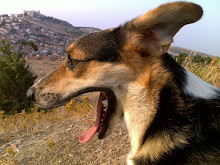
It certainly seemed possible, as there was clearly a striking similarity between the two streets pictured in the photographs, but the only way to tell would be to go and look at that street again, with a copy of the photograph Manny had sent me. I glanced at my watch. It was nearly midnight. I looked over at Freddie, who  was stretched out on his blanket on his designated sofa, looking about as comfortable as it was possible for a dog to be:

freddie recumbent

Freddie  did not look like a dog who wanted to go anywhere anytime soon.

Well, tough.

We were on a mission.

Perhaps not a Mission from God, but a mission, just the same.

‘C’mon Fred,’ I said briskly. ‘We’re going for a walk.’

(to be continued)


The image below shows the diary entry of Manny’s father, Evmenis Paraschos, then 14 years old,  for 25th September, 1922, the day the family left Ayvalik (also known in Greek as Kidonies) to go into exile.

 PapouEvmDiary1TRANSL

Many thanks to the Paraschos family for providing me   with the images used above, and also for sharing their collective memories both of the family’s life in Ayvalik and their experience of becoming refugees, on which much of this post was based.

Sunday, June 13, 2010

Silent, in a Camel Barn in Ayvalık

Then felt I like some watcher of the skies
When a new planet swims into his ken;
Or like stout Cortez, when with eagle eyes
He stared at the Pacific—and all his men
Look'd at each other with a wild surmise—
Silent, upon a peak in Darien.

                                                                                                                 John Keats

The problem I have always had with Keats’ poem ‘On first looking into Chapman’s Homer’ is Stout Cortez. I imagine him, red-faced and dangerously overweight, stuffed into an uncomfortably tight leather tunic, not standing up straight on the peak in Darien for that first magical glimpse of the Pacific Ocean, but bending over, wheezing and gasping for breath after the exertion of getting up there, and quite unable to appreciate the view.

Keats was, of course, using the word ‘stout’ in a different sense to the one above, but there's no helping it: for me, the image of Stout Cortez will always be that of John Prescott in a Conquistador’s uniform. And looking at portraits of Cortez, that image doesn't seem too far from the truth.

Nevertheless, the poem does convey vividly the idea of the life-changing moment: when, quite without warning, you come upon a person or place or idea that alters everything, and the boundaries of your previous world slip and slide in an instant, opening up new, and previously quite unthought of, horizons. For me, that moment came on a sunny day in January 2007, when I walked into a camel barn in Ayvalık, a town on the north Aegean coast of Turkey.

I first came to Ayvalık quite by chance, when I was teaching at a university in the Turkish capital, Ankara, and thinking of buying a house in Turkey. A Turkish friend suggested that I should consider Ayvalık, a town famous for its beautiful location on the Aegean coast, surrounded by islands, for its Ottoman Greek architecture, and for its delicious golden olive oil. We came to Ayvalık for a weekend, and from the moment I first saw the town, I never considered buying a house anywhere else.

Ottoman Greek, in terms of architecture, refers to houses built before 1923, (when the Ottoman Empire came to an end and was replaced by the new Turkish Republic) by the Orthodox Greek Christians who were the principal occupants of this part of Asia Minor under the Ottoman Empire.
Many of the houses in Ayvalık are built in the style of the Greek neo-classical revival - square stone boxes, with pediments - like the one in the photograph on the right, which belongs to my next door neighbour N, one of Turkey's most famous rock stars (and also an architect).


 Others are built in the traditional Ottoman style, with an overhanging upper storey, giving them a slightly mediaeval air, although the town is only about 400 years old: it was founded by people looking for a safe place to live on the mainland, to escape from continual pirate raids on Lesbos (which lies just off-shore) and other Aegean islands.

The old town in Ayvalık contains just under 2,000 Ottoman Greek houses, in varying states of repair from fully restored, like this:


 to falling down - literally- like this:


The house I ended up buying, with its attached camel barn, was somewhere in between, but was distinguished by being one of the most hideously modernised houses in Ayvalık. The picture of the house on the estate agent's web site looked deeply unpromising. It was 100 years old, but you wouldn't have known it: in a town full of beautiful swans, this house was a serious ugly duckling:


I only went to see it  because there was some kind of stone 'studio' in the garden, and I was looking for somewhere containing at least one really big room, to house all my books. The inside of the house turned out to be much, much better than its dispiriting exterior. As it stood on a corner, there were many windows, and the house was filled with light. The rooms were large, with high ceilings. Although most of the original features had been removed, there remained one tall, typically Greek, extravagantly-pedimented cupboard, which alone almost justified buying the house:


The 'studio' turned out to be this, the sad skeleton of a once lovely stone building, the  windows and doors long gone, and the massive stone walls coated with whitewash:


It was, the emlakçı (estate agent) told me, a camel barn, about 150 years old, and thus rather older than the house. It was built in the days when camels were the main form of transport for bringing in the olives and other produce from the surrounding countryside, and was used to stable the camels whilst their owners were busy disposing of their produce in the marketplace close by.

As soon as I walked inside the camel barn, however, I stopped hearing what the emlakçı was saying: I didn't see the empty door and window spaces, the concrete floor piled with junk, or the mess made by whitewash on the pink stone walls.


I saw my library, the one I had been waiting for all my life. The barn was 10 metres long, 6 metres wide and 7 metres high. It was big enough to house all my four thousand or so books, many of which had been in storage for years, because the Oxfordshire cottage I  previously lived in only had room to shelve about half of them. This room would house all my books, and more. For years there had been lurking in my head the image of a great big barn-like room, lined floor to ceiling with books, maybe even with a gallery, as some of my favourite libraries, like the Oxford Union library, have. And here was that room. I could finally make my library, in a camel barn.

That was the moment when the boundaries of my world changed: I decided to buy and restore the house, and then make a library in the camel barn. There was no question about it, not a moment's doubt, even though I had been in the town for less than 24 hours, knew nobody there, and was working in Ankara, 900 miles away. This was going to be my library.

Reader, I bought that camel barn.

The very next day.