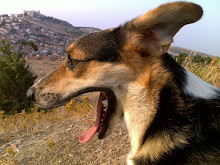
There’s a place up in the woods where my dog always goes quite crazy.
One moment Freddie is bounding along happily, his ears and tail flapping in the breeze, full of doggy joy at being out in the woods and running free. Then, always in exactly the same place, he suddenly stops dead and starts snarling and growling, running round in ever decreasing circles, snapping and lunging, as if facing up to some unseen enemy. But of course there is nothing, and no-one, there.
I often wonder if this might be where some of the bodies are buried.
My last post described how in September 1922 The Orthodox Greek Christian population of Ayvalik was expelled by the Turkish army: 3,000 able-bodied males over the age of 18 were sent on forced marches to work camps in the Anatolian interior – from which only 23 ever returned - whilst women, children and the elderly were evacuated onto boats which took them to Greece.
Not everyone left, though.
Ayvalik and its neighbouring island of Cunda constituted an important centre for Orthodox Greek Christianity. There were nearly 50 churches and monasteries in the area, including the Taksiyarhis Cathedral on Cunda (seen in the photo below as it is today, empty and unrestored) , seat of the local bishop, Gregorias Orologas.

The Greeks of Ayvalik, and their clergy, had traditionally enjoyed good relations with the Ottoman authorities. In 1770 an Ottoman admiral, Cezayirli Gazi Hasan Pasha, commanded an Ottoman fleet heavily defeated by the Russians in the Battle of Chesma, a short way down the coast from Ayvalik. As they escaped, the admiral and some of his men were given shelter in Ayvalik by a Greek priest unaware of who they were.
When Hasan Pasha later became Grand Vizier of the Ottoman Empire, he showed his gratitude by granting Ayvalik virtual autonomy as a Greek enclave within the Ottoman domains, with self-government and exemption from many taxes. Ayvalik prospered, and went on to become the second most important Greek commercial and cultural centre on the Aegean coast, after Smyrna. The town’s prosperity was derived principally from the olive oil industry, and its wealth was evident not only in the grand neo-classical stone mansions of wealthy merchants, but also in the magnificent churches of Ayvalik and Cunda.

The Asia Minor Greeks, it should be remembered, did not disappear from Anatolia overnight: it was a long, slow, agonising process bracketed at one end by the start of the Greek War of Independence against the Ottoman Empire in 1821, leading to the creation of the Greek Republic in 1832, and at the other end by the Population Exchange between Greece and Turkey under the Treaty of Lausanne, in 1923.
Thus by the time the last of the Ayvalik Greeks were evacuated in 1922, the people of Ayvalik had already been affected by the gradual worsening of relations between Muslims and Christians within the Ottoman Empire from Anatolia to the Balkans, and in particular had suffered a great deal during the Turkish War of Independence, when they were accused of collaborating with the invading Greek Army.
Nevertheless, even with the Greek army defeated, Smyrna burned to the ground, and the victorious Turkish army approaching Ayvalik, it was impossible for the inhabitants to believe that Ayvalik’s 300 year history as an Asia Minor Greek town was over. At this point, the local authorities made a huge error: they docked all the boats to prevent people from leaving, in the hope that this demonstration of good faith to the Turks would lead to the safety of the townspeople, and in time a return to Ayvalik’s previous well-ordered existence.
The chairman of the meeting which made this decision was Bishop Gregorios Orologas, and he was also at the head of the deputation welcoming the Turkish cavalry when they rode into town on September 19th, 1922. Unfortunately this warm welcome for the Turks, which also included an entertainment with music and dancing, made no difference at all to the fate of the Ayvalik Greeks, who were shortly afterwards dispersed as described above.
And the ones who didn’t leave?
The following passage is from 'Twice A Stranger', Bruce Clark’s fascinating, and definitive, book about the Population Exchange, which has a chapter entitled ‘Ayvalik and its ghosts’* :
‘Gregorios and all the other clergy of the town were taken to a lonely spot outside the town and killed: the bishop is said to have died of a heart attack shortly before an attempt to bury him alive. Ironically some of those who died were choristers and vergers who donned clerical clothes in the belief that they would be treated with greater respect.’

In that place up in the woods, the lonely place high above the sea where Freddie always goes crazy, the ground undulates strangely, in a way quite atypical of the local landscape. The rest of the hilltop is flat, but in this one area there is a series of low mounds and hollows, as if the earth was disturbed there a long, long time ago.
And every time Freddie’s hackles rise, and he starts growling and yapping and chasing things that aren’t there, I wonder if this place might be where some of those bodies are buried.
* My posts about the Population Exchange draw heavily on this book, which is by far the best English language source on the subject.