Showing posts with label Freddie. Show all posts

Friday, May 6, 2011

Walking on wild flowers

yellow, pink and sea2

It’s been a long time since I’ve posted here on the Camel Barn Library, and many people have asked me in the last few months, with varying levels of impatience, if I am EVER going to finish the saga of the Paraschos house, and finally satisfy everyone’s curiosity by giving them a look inside it.

Please accept my apologies, patient – and not so patient – readers. I am well aware of how annoying it is when a story stops abruptly, without finishing, and my only explanation is that life got away from me, rather, during the autumn and winter and so, by extension, did the blog.  But now it’s spring-time in the Aegean, and time to get going again with the blog, and much else. I will be returning to the subject of the Paraschos house shortly, but to celebrate restarting the Camel Barn Library, and to remind both myself and you just why I love this place so much, today’s post  is simply about walking in, and on, the wild flowers which cover the wooded hills around Ayvalik at this time of year.

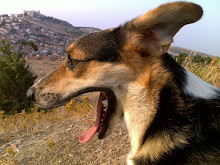
Ayvalik is both built on and surrounded by hills, and if we walk straight up the steep sokaks (alleys) which lie behind the Camel Barn – no inconsiderable feat for me, though less so for my dog Freddie, who likes nothing better than bounding his way uphill on a brisk vertical run, preferably in pursuit of a motorbike – we can be in the woods in less than 10 minutes. The trees are mostly the graceful Mediterranean umbrella pines that grow throughout Southern Europe, North Africa, and the Levant.

purple and pines

The pines maintain their vivid greenness throughout the year, which is particularly welcome in the intensely hot, dry summer months, when all the undergrowth dries up and the ground becomes uniformly dun-coloured; at this time of year, however, the grasses are green and flourishing and so are many species of wild flowers, notable amongst them lavender and dog roses, endless acres of which cover the rocky ground in between the trees:

lavender ad inf

dog roses, lavender2

Although all the woods around Ayvalik are lovely, the areas closest to the town are sadly marred by litter, and fly-tipping. People here don’t, on the whole, use the woods for walking, running, or dog-walking; in the warm months they come to the woods by car or motor-bike, and leave behind them a constantly replenished tide of broken bottles, cigarette packets, plastic bags and other detritus. Builders also frequently dump piles of building rubble by the road going through the woods, even though the town tip is only a five minute drive away:

building rubble in woods

The constant desecration of a place of such astonishing natural beauty makes me want to weep; this is a problem that is found throughout Turkey, and not just in Ayvalik, and also of course in Europe, although I’ve never seen it on such a large scale anywhere else. The town council recently put up a couple of notices on the road that winds through the woods, forbidding the dumping of rubbish; the very next day I saw, walking past, that someone had neatly deposited a heap of building rubble just underneath one of the new notices.  A few days later, approaching the same spot, I saw black smoke billowing into the air: someone had tipped an old sofa down the hillside, and set fire to it.

sofa on fire2

However, if you walk far enough through the woods, away from the town, you eventually get further than people can be bothered to go to drink beer, or dump their rubbish; you can then walk for miles over the hills along unmade fire roads, free of human detritus, and the only people you are likely to encounter are beekeepers. The Ayvalik area is famous for its pine and wildflower honey, and throughout the woods are neat lines of beehives, each weighted down with a stone to prevent its lid being blown away by the frequent high winds.

beehives among the flowers

The beekeepers can be found, occasionally, tending to their hives, dressed in their slightly spooky beekeeping outfits, with veils attached to wide-brimmed white hats.

beekeepers in the woods

Apart from the beekeepers, no one else much seems to frequent the more remote parts of the woods, except me and Freddie. The  only sounds are the wind, sighing through the pine trees, the occasional buzzing of the bees, and the scrabbling of Freddie’s paws as he excavates yet another hole amongst the flowers:

freddie digging hole amongst flowers2

The further you go, and the higher you get, the more wild flowers there are, and after about 90 minutes’ walking there is a wide, steep track, climbing to a high point from where you can look inland towards the mountains, and out across the sea. This track  is, for a couple of weeks a year, completely carpeted in purple flowers:

purple flowery road 

the only way is up

By the time we get to the top of the purple flowery road, Freddie and I will have been walking for a couple of hours, and are ready to take a rest on the summit of the hill, from where we can look out over the Aegean to the islands of the archipelago, and back across the hills to Ayvalik (which you can see just to the right of Freddie’s head in the photo):

Freddie in the flowers

It’s a long walk home, but during April and May we walk this way as often as possible; it’s always beautiful in the hills around Ayvalik, but when the wild flowers are blooming in such spectacular abundance, the beauty is quite overwhelming.  It seems strange that so few people walk in the hills, or see the flowers, but in 3 years of regular walking through these woods, we have met only a handful of people. It’s rather like having our own private National Park…

To my shame, I am unable to give a name to most of the many different species of flowers which are currently blooming here, beyond the obvious lavender, dog roses, daisies and poppies; next year I will have to buy a field guide to the flora of Asia Minor, and see how many different flowers I can identify, but to give you an idea of their variety, the picture below shows a small bouquet I gathered last week for a friend whose health currently prevents her from walking in the hills  - and yes, I know that in the UK you’re not meant to pick wild flowers, but here there are, quite possibly, millions of them, mostly blushing unseen. I feel extraordinarily fortunate to be able to spend so much time walking through the flowers, marvelling at their beauty, and immersing myself in the deep, deep quiet of the woods.

bouquet of wild flowers

Monday, October 18, 2010

An email from a ghost: Part III

ParaschosAivali3 The Paraschos family in 1922

To new readers: this is the third post in a series about the search for a lost house in Ayvalik. In order to follow  the narrative, it would be best to start by reading Part I and Part II.

September is a beautiful month in Ayvalik. Every year, at some time during the first two weeks of the month, the temperature drops suddenly: overnight,  the searing summer heat of the Aegean disappears and is replaced by soft sunny days, cooled by breezes off the sea, as the town relaxes into a quiet golden autumn, with the tourists mostly gone and the children back at school. Should you ever wish to visit Ayvalik, September is a very good time to come.

When I imagine September, 1922 in Ayvalik, I see the town bathed in that same soft sunlight, the breeze rustling through the pines, and the fear etched on the faces of  its remaining Greek population, as they are finally forced to accept that the tsunami of the Asia Minor Catastrophe is not, as they had hoped and prayed, going to pass them by.

On the evening of the 24th September, 1922, Dr. Emmanouil Paraschos (pictured above with his family in a photograph taken earlier in 1922) who, like so many others, had been convinced that if the Greeks of Ayvalik stayed put, and stayed quiet, the war would wash harmlessly by them, came home from work in one of Ayvalik’s two hospitals and, deeply distressed and in tears, told his wife Vrysiis that there was no longer any choice in the matter: the time had come for them to leave.

The marauding bands of Turkish irregular soldiers - ‘Tsetes’, in Greek - who had been in the area since August, were now burning Greek villages just along the coast, and killing the inhabitants, he said; soon they would do the same in Ayvalik itself, if any of the Greek inhabitants remained. All able-bodied males over the age of 18 were to be rounded up and sent to labour camps in the Anatolian interior; only the old men, the sick, and women and children would be allowed to leave. There were Allied ships in the harbour waiting to take them  into exile; they would sail the following morning.

Having told his wife, Dr Paraschos dried his tears and, with difficulty,  pulled himself together in order to appear strong and calm whilst delivering this dreadful news to their five children: Athanasios, aged 18, Evmenis, 14, Polyxeni, 12, Kosta, 10, and Yannis, 2.

What was particularly painful for him was that whilst, as  a prominent Ayvalik doctor with many influential Turkish friends, Emmanouil Paraschos had managed to gain an exemption from being sent to a labour camp, and was to be one of the few adult Greek men allowed to leave Ayvalik, he had been unable to obtain any such exemption for his 18 year old son, Athanasios. It was therefore decided that Athanasios would take the risk of going into hiding with Turkish friends, and try to escape to Mytilene later, rather than take the much greater risk of enduring a forced march into the Anatolian interior towards the grim privations of a labour camp.

The family spent the night making preparations to leave their home, possibly for ever. The first thing they did was to cover the windows with blankets, to ensure they could not be seen by any Tsetes who might be roaming the streets already. Then, they set about gathering together what little they could take with them. Vrysiis went to a cupboard and took out 5 blankets, giving one to each of the children. They would be able to take only what they could  manage to carry on their backs, wrapped in a blanket.

When the children had sorted out a couple of changes of clothes each,  a few toys and books, and their stamp collections, they were sent to bed. Then Vrysiis got down to work: she took out  all her jewellery from the box in which it was stored and, through the hours of the night, carefully unpicked the seams of the coats of the family members, inserted  all the pieces of jewellery, and then just as carefully sewed up the seams again so that the jewellery was invisible.

Once the jewellery was sewn up into the coats , and ready to be transported into exile safely hidden,Vrysiis got on with her next task: cleaning the house. It was a matter of honour to her that, whatever the circumstances of their departure, she could not leave behind a dirty house for others to find; so, as the children slept and the darkness of the night began to edge towards a grey dawn, Vrysiis swept, scrubbed and mopped.

Perhaps this mindless, physically demanding activity also helped her to endure the intense fear and anxiety of this terrible night, knowing that in the morning she, her husband  and children would be forced not only to abandon their home and their lives in Ayvalik and sail away to a highly uncertain future, but also to leave behind the family’s eldest son, in a position of great danger. By the time the sun came up over the hills behind Ayvalik, and cast its rays over the Aegean towards Mytilene, the kitchen of the Paraschos house was immaculate, the tiled floor gleaming, all the utensils, ranged on their shelves, sparkling clean.

The next morning the Paraschos family, along with hundreds of others, all carrying similar small bundles of possessions, walked down to the harbour. There the boats were waiting to take them as refugees to the island which lies just offshore, and is clearly visible from Ayvalik:  Mytilene, also known as Lesbos,  once part of the Ottoman Empire, but by 1922 belonging to the Republic of Greece, and a safe haven for the Ayvalik Greeks.

Although the family were able to take some portable valuables – a small amount of money,  jewellery, and  a couple of stamp collections  -  with them into exile,  they left behind virtually everything they owned: a fine, three storey house, one of the beautiful neo-classical stone mansions of Ayvalik, full of  elegant furniture, rugs, china, art, and books; all the possessions of a well to do Asia Minor Greek professional family at the beginning of the 20th century. The Paraschos family  would never be able to reclaim that house, or those possessions, but were fortunate in that they, unlike many others,  escaped with their lives (Athanasios, with the help of Turkish friends, managed to escape to Mytilene and join the rest of the family a few days later).

Those lives would be eventually be remade and lived out successfully in other countries – Greece and  the United States – but the entire Paraschos family would always carry with them, and pass on to their children, and their grandchildren, the sadness of exile, of refugeedom, and the enduring memories of the beautiful house in Ayvalik that was once their family home, on the western shores of Asia Minor, the homeland of their ancestors.

And that lost house was the one I was now trying to find, so far unsuccessfully, on behalf of one of Dr Paraschos’ grandchildren, another Emmanouil (Manny). It happens very often in families that the younger generations fail to appreciate that their older relatives, keepers of the family memories and history, much of it never written down, will not be around for ever to answer questions, and thus it was with the Paraschos family: by the time Manny got round to wondering if it might be possible to find the lost family home, most of the family members who had ever been there were dead, and there were few  clues left as to its exact whereabouts in Ayvalik.

What Manny did find, however, on searching through the papers of his father, Evmenis, the second son, who died in 1975, was several copies of a very small and very dark photograph of a house -

paraschos house2

- and this is the photograph he emailed to me a few weeks ago, as a possible candidate for the Paraschos family house.

His father Evmenis had, in the early 1950s, been permitted to come back to Ayvalik from Greece for a short visit of a couple of days,  and had walked the streets (all by then renamed, in Turkish) of the much changed town, looking for the house he had left as a child three decades earlier. This was not, it should be noted, in an attempt to reclaim the house from its new owners: under the terms of the Treaty of Lausanne, 1923, all those exiled from Turkey to Greece, and vice versa, in the Population Exchange forfeited not only the citizenship of the country they left, but all the property they were forced to leave behind there.

Manny thought that although the photograph of the house was unlabelled, his father must have taken it on this brief visit to Ayvalik. Further, as there were several copies, the photograph must be of some significance: it could well be the family home. This photo, this house, were all, for the moment, that  we had to go on.

Could I find the house in the photograph for him?

You would have to be intimately familiar with the topography of  Ayvalik, the old town spread across several hills sloping down to the Aegean, the warren of  steep, narrow cobbled streets and tiny alleyways, the whole vast mélange of thousands of old buildings, in all possible states of repair and disrepair, from ‘a pile of stones’ and ‘ in ruins’, through ‘partially derelict’ and ‘in need of some urgent attention’, up to and including ‘modernised out of all recognition’, to understand quite how much my heart sank when I saw that photograph.

The photograph was so small and so dark that you couldn’t make out much detail, and since the house in the picture was of only one storey, it was clear that it must be one of the many larger houses in Ayvalik that had lost its upper storey, or storeys, in the major earthquake which hit the town in the 1940s. Along with the upper part of the house would have gone a lot of distinguishing detail: there are many once sizeable houses in Ayvalik with missing upper storeys and, to the casual glance at least, they all look rather alike.

I sat and stared at the photograph, rather dispiritedly. I imagined spending the next few weeks wandering the streets of Ayvalik, a print-out of the photo in hand, trying to find anything that resembled it. The old town of Ayvalik is BIG. It has a number of separate neigbourhoods, with some of which I am only passingly familiar. Although I’ve lived here for over two years, and walk around with my dog Freddie every day,  I’m still constantly discovering streets and alleys which I have never ventured down – or, more likely, as the town is built on hills, up – before. I live in the lower part of the town, equidistant between the pine woods and the sea, but this house could be anywhere, if it still existed at all.

I continued to stare miserably at the photograph, beginning to regret that I had so blithely undertaken the task of finding the Paraschos house. Then I noticed something. On the left hand side of the photograph, on the opposite side of the narrow street from the house which might or might not be the Paraschos house, there was a house with a protruding window on the first (or for Americans, the second) floor, a common feature of Ottoman, and Ayvalik, architecture. What was unusual about it, though, was that the window looked very low, not more than 8 or 9 feet above the ground; generally, in this town of tall, thin 3 storey houses, they are much higher, as in the photograph below:

091020105772

I vaguely remembered  walking down a street with just such an unusually low protruding window, one low enough so that you could reach up and touch it, only a few days before  - but where the hell had it been?

Then I remembered that I’d been in the street to photograph a horse and cart I spotted tied up there, and that the low protruding window had been somewhere beyond the horse and cart. Going into the photo files on the computer, I started to search and eventually found this embarrassingly incompetent photograph, with the light all haywire, which would never be seeing the light of day on this blog were it not an important step in the search for the Paraschos house:

240820104678[1]

However, my photographic deficiencies notwithstanding, if you look closely at the photograph you can see that behind the heap of tomatoes in the cart is a protruding window, not very high up, opposite which is a line of low one storey buildings. 

Now go back and look at the photograph Manny sent me, of the house with a similar low protruding window opposite the one storey house, bearing in mind that the two photographs are taken from the opposite ends of their respective streets, one showing the window on the right, one on the left.

That night I looked at one photo, then the other, back and forth, over and over again. Could these two photographs, taken from different angles, be of one and the same street? Could I have already found the Paraschos house, without knowing it, on the day I had recently spent photographing horses and carts (still a common form of  transport  in Ayvalik)?

It certainly seemed possible, as there was clearly a striking similarity between the two streets pictured in the photographs, but the only way to tell would be to go and look at that street again, with a copy of the photograph Manny had sent me. I glanced at my watch. It was nearly midnight. I looked over at Freddie, who  was stretched out on his blanket on his designated sofa, looking about as comfortable as it was possible for a dog to be:

freddie recumbent

Freddie  did not look like a dog who wanted to go anywhere anytime soon.

Well, tough.

We were on a mission.

Perhaps not a Mission from God, but a mission, just the same.

‘C’mon Fred,’ I said briskly. ‘We’re going for a walk.’

(to be continued)


The image below shows the diary entry of Manny’s father, Evmenis Paraschos, then 14 years old,  for 25th September, 1922, the day the family left Ayvalik (also known in Greek as Kidonies) to go into exile.

 PapouEvmDiary1TRANSL

Many thanks to the Paraschos family for providing me   with the images used above, and also for sharing their collective memories both of the family’s life in Ayvalik and their experience of becoming refugees, on which much of this post was based.

Sunday, July 11, 2010

Where the bodies are buried

 DSC00188

There’s a place up in the woods where my dog always goes quite crazy.

One moment Freddie is bounding along happily, his ears and tail flapping in the breeze, full of doggy joy at being out in the woods and running free. Then, always in exactly the same place, he suddenly stops dead and starts snarling and growling, running round in ever decreasing circles, snapping and lunging, as if facing up to some unseen enemy. But of course there is nothing, and no-one, there.

I often wonder if this might be where some of the bodies are buried.

My last post described how in September 1922 The Orthodox Greek Christian population of Ayvalik was expelled by the  Turkish army: 3,000 able-bodied males over the age of 18 were sent on forced marches to work camps in the Anatolian interior – from which only 23 ever returned -  whilst women, children and the elderly were evacuated onto boats which took them to Greece.

Not everyone left, though.

Ayvalik and its neighbouring island of Cunda constituted an important centre for Orthodox Greek Christianity. There were nearly 50 churches and monasteries in the area, including the  Taksiyarhis Cathedral on Cunda (seen in the photo below as it is today, empty and unrestored) , seat of the local bishop, Gregorias Orologas.

 cundacathedral


The Greeks of Ayvalik, and their clergy, had traditionally enjoyed good relations with the Ottoman authorities. In 1770 an Ottoman admiral, Cezayirli Gazi Hasan Pasha, commanded  an Ottoman fleet heavily defeated by the Russians in the Battle of Chesma, a  short way down the coast from Ayvalik. As they escaped,  the admiral and some of his men  were given shelter in Ayvalik by a Greek priest  unaware of who they were.

When Hasan Pasha later became Grand Vizier of the Ottoman Empire, he showed his gratitude by granting Ayvalik virtual autonomy as a Greek enclave within the Ottoman domains, with self-government and exemption from many taxes. Ayvalik prospered, and went on to become the second most important Greek commercial and cultural centre on the Aegean coast, after Smyrna. The town’s prosperity was derived principally from the olive oil industry, and its wealth was evident  not only in the grand neo-classical stone mansions of  wealthy merchants, but also in the magnificent churches of Ayvalik and Cunda.

taksiyarhis2

The Asia Minor Greeks, it should be remembered, did not disappear from Anatolia overnight: it was a long, slow, agonising process bracketed at one end by the start of  the Greek War of Independence against the Ottoman Empire in 1821, leading to  the creation of the Greek Republic in 1832, and at the other end by the Population Exchange between Greece and Turkey under the Treaty of Lausanne, in 1923.

Thus by the time the last of the Ayvalik Greeks were evacuated in 1922, the people of Ayvalik had already been affected by the gradual  worsening of relations between Muslims and Christians within the Ottoman Empire from Anatolia to the Balkans, and in particular had suffered a great deal during the Turkish War of Independence, when they were accused of collaborating with the invading Greek Army.

Nevertheless, even with the Greek army  defeated, Smyrna burned to the ground, and the victorious Turkish army approaching Ayvalik, it was impossible for the inhabitants to believe that Ayvalik’s 300 year  history as an Asia Minor Greek town was over.  At this point, the local authorities made a huge error: they docked  all the boats to prevent people from leaving, in the hope that this demonstration of good faith to the Turks would lead to the  safety of the townspeople, and in time a return to Ayvalik’s previous well-ordered existence.

The chairman of the meeting which made this decision was Bishop Gregorios Orologas, and he was also at the head of the deputation welcoming the Turkish cavalry when they rode into town on September 19th, 1922. Unfortunately this warm welcome for the Turks, which also included an entertainment  with music and dancing, made no difference at all to the fate of the Ayvalik Greeks, who were shortly afterwards dispersed as described above.

And the ones who didn’t leave?

The following passage is  from 'Twice A Stranger',  Bruce Clark’s fascinating, and definitive, book about the Population Exchange, which has a chapter entitled ‘Ayvalik and its ghosts’* :

‘Gregorios and all the other clergy of the town were taken to a lonely spot outside the town and killed: the bishop is said to have died of a heart attack shortly before an attempt to bury him alive. Ironically some of those who died were choristers and vergers who donned clerical clothes in the belief that they would be treated with greater respect.’

060720103716

In that place up in the woods, the lonely place high above the sea where Freddie always goes crazy, the ground undulates strangely, in a way quite atypical of the local landscape. The rest of the hilltop  is flat, but in this one area there is a series of low mounds and hollows, as if the earth was disturbed there a long, long time ago.

And every time Freddie’s hackles rise, and he starts growling and yapping and chasing things that aren’t there, I wonder if this place might be where some of those bodies are buried.


* My posts about the Population Exchange draw heavily on this book, which is by far the best English language source on the subject.

Sunday, June 6, 2010

The truth about cats and dogs...

I awake to the realisation that I left the kitchen door open last night and that not one, but two, feral cats are in the house.

Shortly afterwards Freddie, my dog, realises this too.


There are breakages.

For does not an old Turkish proverb say: 'A terrified cat will always choose to rampage through a tray of wine glasses rather than head for the door standing wide open'?

After several minutes of extreme havoc and a considerable amount of collateral damage, the feral cats are ejected. I sweep up all the broken glass, feed the dog and yowling resident cats, and take a cup of coffee into the courtyard to sit awhile and regain my equilibrium.


I sink gratefully into the Lloyd loom garden chair and raise the mug of coffee to my lips, but even as I finally take the first sip of coffee of the day, a loud clacking noise starts coming from inside the camel barn. I sigh, knowing what the noise is. My cat Ollie is sitting inside the camel barn, batting the door of the cat flap back and forth with his paw. CLACK! CLACK! CLACK! goes the door. He will continue doing this until I get up, walk over to the camel barn doors, and lift up the cat flap door from the outside, thus allowing him unimpeded egress from the camel barn into the courtyard.


Ollie is 15, very old in cat years, and I indulge him in this practice on the grounds that he may be going senile and have forgotten how to use the cat flap. The possibility remains, however, that he simply sees no necessity to bother with pushing his way through the cat flap when an indentured servant is available to do it for him. I strongly suspect that he manages to get through that door perfectly well on his own when I am not in the vicinity.

With Ollie ushered safely through the cat flap I manage, finally, to drink a few sips of coffee and sit back in my chair, enjoying the scent of the jasmine growing up the courtyard wall.

Then two things happen simultaneously: Ollie strolls over to the flower bed in which the jasmine is planted, just next to where I am sitting, and defecates neatly, and copiously, right in the middle of it. The scent of the jasmine is immediately replaced by something infinitely less pleasant. Meanwhile, Freddie begins to exacavate, with enormous, earth-spattering enthusiasm, the large terracotta pot in which I have recently planted some not particularly robust geraniums.

Once I have disposed of Ollie's little gift and swept up the earth and broken flowers, I bow to the inevitable and decide to take Freddie for a long walk to dissipate some of his energy. As I re-enter the house via the camel barn, in which I will be entertaining some friends for dinner this evening, I notice a very strong odour of Eau du Feral Cat, a souvenir of last night's uninvited guests. When a cat sprays the smell is both disgusting and extremely difficult to eradicate. At this point it becomes necessary, for the sake of my mental health, to move into a state of extreme denial, and I decide to think about this problem later.

Freddie and I set off on our walk, and make our way up to the pine woods with only two motorcycle-chasing incidents (not bad going), and no one moved to throw anything at Freddie or me because they don't like dogs (also good). The day is looking up. We continue to climb and, after an hour or so, get to the high point of the walk, where there is an extraordinarily beautiful view over the Aegean and the islands of the Ayvalik archipelago, shown here in a photo taken last week:


At this very moment, however, as Freddie sits on the ground panting happily and I, gazing at the view, am struck anew by the incredible beauty of this place, the electrical storm which has been threatening for several days finally arrives, with thunder, spectacular lightning effects and torrential rain. We are some distance from any form of shelter, and within minutes I am soaked to the skin. I sit down on the wet ground next to my big, wet dog, give him a big, wet hug and, huddled together, we sit and watch the sheet lightning illuminate the sky over the sea.